绝命毒师
New advances in lunar soil research offer scientific evidence to unravel mystery of moon’s 'two faces'_我的网站

A | 讯 据中国地震台网正式测定,8月20日10时47分在印尼弗洛勒斯岛地区发生5.6级地震,震源深度20公里,震中位于南纬8.35度,东经120.65度。版权申明:凡注有“”或电头为“”的稿件,均为独家版权所有,未经许可不得转载或镜像;授权转载必须注明来源为“”,并保留“”的电头。

B | 。
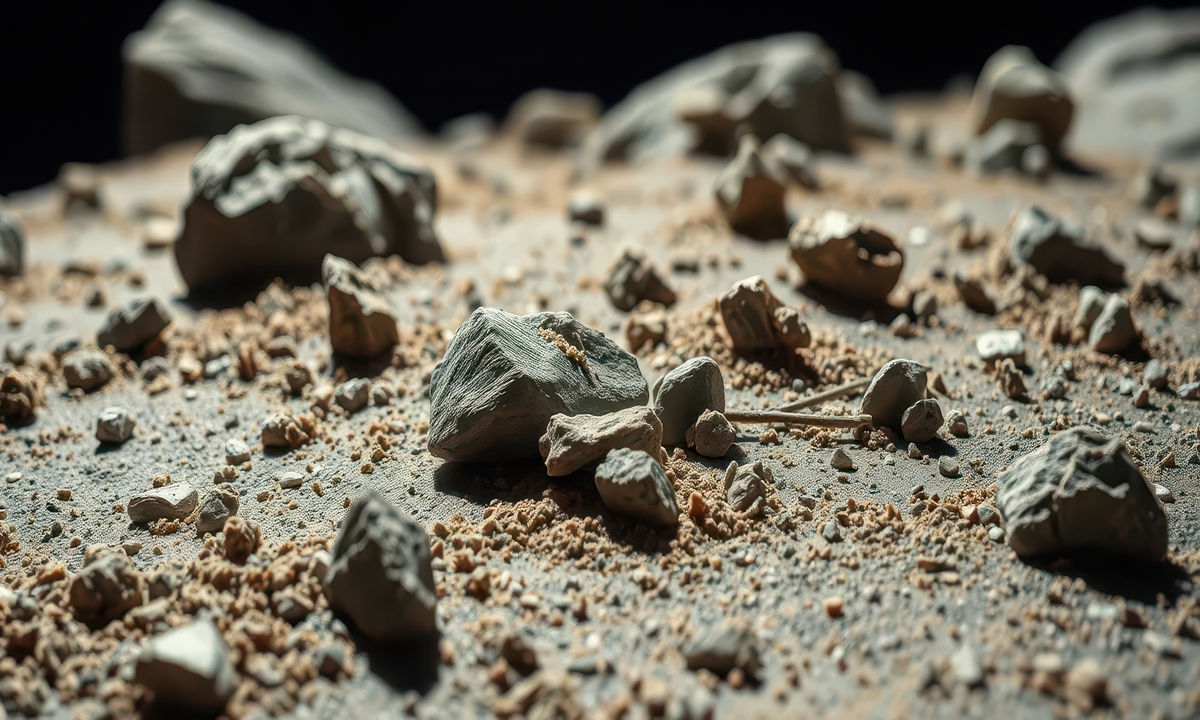
Lunar soil Photo: IC
Chinese scientists have made new progress in the study of lunar soil samples returned by the Chang'e-6 mission, providing fresh evidence to the striking differences between the moon's near and far sides, which have long puzzled scientists.
Because the moon is tidally locked to Earth, its rotation period matches its orbital period, meaning the same side always faces Earth. The moon's near side features vast dark basaltic plains known as lunar maria, while its far side is dominated by bright highlands with far fewer maria, creating a striking contrast between the two sides. Why does the moon have such "two faces"?
Scientists studying the moon's early formation and evolution have long used the lunar magma ocean model as a basic framework. Under the model, the chemical and isotopic characteristics of different types of lunar magma can be explained by the mixing of different components in varying proportions after the magma ocean cooled, Guangming Daily reported on Saturday.
However, previous lunar samples were collected only from the moon's near side, while significant differences exist between the near and far sides in their topography, composition and internal structure.
Against this backdrop, the research team from Institute of Geology from Chinese Academy of Geologist Sciences studied feldspathic impact-melt rocks in lunar soil samples returned by the Chang'e-6 mission. Using China's first independently developed ion probe system, researchers conducted a comprehensive analysis to test the lunar magma ocean model and examine how large impacts reshaped reservoirs in the lunar crust and mantle.
Through high-precision analyses, the team identified key clues to the moon's evolutionary history, suggesting that the stark differences between its near and far sides may be linked to the ancient giant impact that formed the South Pole-Aitken Basin.
The study found that the massive impact continued to profoundly reshape the lunar crust and upper mantle after the lunar magma ocean had solidified, fundamentally altering the material composition of parts of the moon's far side.
The findings add to the traditional lunar magma ocean model, suggesting that the formation and preservation of the moon's crustal and mantle reservoirs may have varied significantly from region to region and cannot be fully explained by a single, uniform model of primordial magma-ocean differentiation.
The research provides new scientific evidence for understanding the differences between the moon's near and far sides, while offering fresh insights into the moon's complex evolutionary history, according to Guangming Daily.
Global Times
。
Current article:http://c95134s.aiwengchuanzuodahuai.shop/news/20260826_330984.html
Published on:09:23:35


 光速下班!王楚钦/孙颖莎横扫对手晋级8强
 【现货】8月26日全国各地区鸡蛋现货价格汇总
 长江流域旱情严重,对秋粮有何影响?_长势_全国
 杭州PVC市场弱势盘整
 धनु से मीन Aaj Ka Rashifal 27 अगस्त 2025: कुंभ वाले जीवन में अपनाएं नए विचार, जानें बाकी राशियों का हाल
 低空经济“热潮”催生新岗位 无人机操纵员人才缺口达100万


